
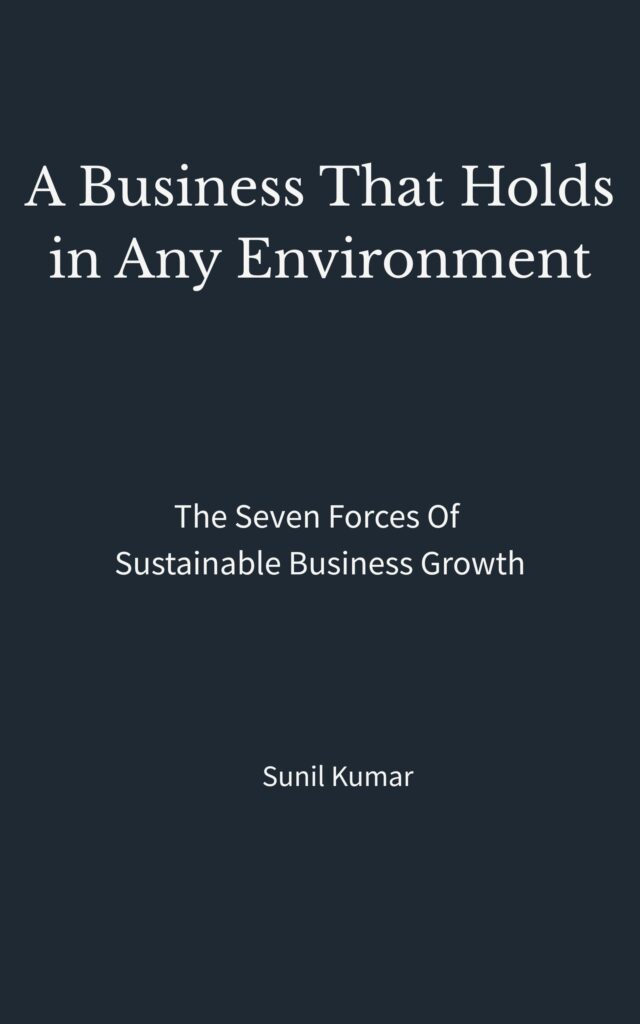
A Business That Holds
in Any Environment
This book is about stabilising judgement — so that accelerating growth can be sustained.
Written for founders, leaders, and professionals whose decisions carry increasing weight.
Explore the Business Growth Lab →
Why I wrote this book
Most businesses do not fail because of lack of effort, intelligence, or intent.
They fail when growth begins to test judgement under pressure.
The statistics are well known.
Many businesses do not survive their early years. Most disappear over time. And those that remain are not always healthy — they are simply still standing.
What is less discussed is why this happens, even in organisations led by capable, committed people.
In the early stages of a business, judgement is close to action. Decisions are made near the ground. Feedback is immediate. Errors are visible and recoverable. Growth, while demanding, is forgiving.
As the business grows, this changes.
Distance appears — between decisions and consequences, between intent and impact. Complexity accumulates faster than understanding. Momentum rewards speed even when coherence is eroding. Under these conditions, judgement is no longer exercised in calm. It is exercised under pressure.
This is where failure quietly begins.
Not because leaders stop caring, but because judgement under pressure is a different capacity than judgement in stable conditions. It draws on emotional access — to patience, curiosity, restraint, and perspective — that often weakens as responsibility expands.
Over time, decisions become efficient rather than coherent. Problems are solved quickly, but in isolation. Growth continues, yet fragility takes shape beneath it.
I wrote this book to examine that moment — when growth stops being a reward and becomes a test — and to explore what allows judgement to hold when pressure becomes the constant backdrop of decision-making.
How I could write this book
I could write this book because I have experienced growth under fundamentally different conditions — when it feels protected, and when it becomes exposed.
I began my career in an environment that operated close to monopoly. Scale existed, but competition was limited. Decisions mattered, but consequences were delayed. Systems could absorb inefficiencies. Growth was present, but it was forgiving.
Then the environment changed.
As the organisation moved into a competitive market, the same structures, habits, and assumptions were suddenly tested. Growth was no longer gentle. Feedback loops tightened. Errors carried immediate cost. What once worked began to strain — not because people became less capable, but because the conditions had changed.
After living through this transition — from monopoly to competition, from protected scale to exposed growth — I began to notice a pattern that repeated itself across teams and decisions.
What I observed repeatedly was this:
when environments become complex and stakes rise, leaders often lose access to the emotional states that allow judgement under pressure to hold.
This loss is subtle. It does not announce itself as failure.
It shows up as impatience where curiosity once existed.
As rigidity where flexibility once guided action.
As urgency replacing judgment.
Across roles spanning business development, marketing, sales, and organisational systems, I watched capable people continue to work hard while gradually losing coherence. Decisions were made faster, but with less alignment. Structures multiplied, but clarity weakened. Growth continued — yet it was no longer being carried well.
This was not a failure of intelligence or intent.
It was a failure of resourcefulness under pressure.
This book emerged from tracing that pattern over time — across decisions, systems, and leadership behaviour — and asking a simple but uncomfortable question:
What allows a business — and the people inside it — to hold when growth stops being kind?
Why now
Because the conditions under which people build their working lives are changing — quietly, but fundamentally.
Traditional jobs, in the sense of long, predictable careers within stable structures, are shrinking. Not disappearing overnight, but thinning. Roles are becoming narrower, tenure shorter, and security more conditional.
At the same time, more people are being pushed — and pulled — toward entrepreneurship and entrepreneurial responsibility.
Some choose it deliberately.
Others arrive there by necessity.
Many find themselves somewhere in between: working inside organisations, but expected to think and act like owners.
This shift is often described as opportunity.
What is discussed less is the weight it places on judgement.
Entrepreneurship and ownership demand decisions without full information, without buffers, and often without emotional safety nets. Responsibility arrives before clarity. Pressure precedes confidence. And the consequences of decisions are felt more directly than ever before.
In earlier eras, judgement could mature slowly inside stable systems.
Today, judgement is required early, and under pressure.
At the same time, the pace of growth has accelerated. Technology amplifies reach, but it also compresses feedback. Markets reward speed, yet punish incoherence. Leaders are expected to move quickly, even as complexity outpaces understanding.
Under these conditions, familiar advice — more frameworks, more optimisation, more hustle — often increases fragility rather than resilience.
This book was written for this moment.
Not to prepare people for growth in ideal conditions, but to help them recognise what must hold when certainty is absent, pressure is constant, and responsibility cannot be deferred.
What are the four parts in the book
This book is organised into four parts, each addressing a different requirement of businesses as they grow — not in sequence, but in depth.
1. Orientation
Before tools, frameworks, or decisions, leaders need orientation.
Orientation is about recognising where you are — not aspirationally, but structurally.
It helps surface the forces acting on judgement as growth begins to alter distance, speed, and consequence.
This part of the book is designed to slow the reader down just enough to see clearly — to recognise patterns they may have been living inside without naming.
Orientation restores context before action.
2. Fundamentals
Growth does not break businesses randomly.
It breaks them at predictable pressure points.
The Fundamentals section examines the underlying capacities that must hold as scale increases — clarity of intent, coherence of decision-making, feedback proximity, and emotional resourcefulness under pressure.
These are not techniques to be applied once.
They are conditions that must be continuously maintained.
This part of the book focuses on what quietly erodes first — long before performance metrics reveal trouble.
3. Growth Lab
Growth is where theory stops being helpful on its own.
The Growth Lab section explores how judgement behaves when speed increases, complexity multiplies, and responsibility expands. It examines how capable leaders begin optimising for continuity and efficiency — often at the expense of coherence and consequence.
This is the most diagnostic part of the book.
It is less about answers, and more about learning to notice when fragility begins to form.
4. Integration
Integration is where understanding becomes durable.
The final part of the book focuses on how insights are carried forward — into decisions, structures, and leadership behaviour — without becoming another framework to remember.
Integration is not about doing more.
It is about holding differently.
This section explores how businesses can continue to grow without repeatedly resetting themselves through crisis.
How we help: The Business Growth Lab
The Business Growth Lab is where the ideas in the book are trained, applied, and integrated into real business contexts.
It functions as both a training environment and a consulting engagement — but not in the conventional sense.
The training is not only about learning new frameworks.
It is about developing judgement under pressure — the capacity to make coherent decisions as complexity, speed, and responsibility increase.
The consulting is not about providing answers or prescriptions.
It is about working alongside founders and leadership teams as growth introduces strain — helping them see what is changing, what is eroding, and what must now hold differently.
The Lab works with:
live decisions, not case studies
real organisational tension, not simulations
leadership responsibility as it exists today, not as it is described in theory
In this way, the book and the Lab serve different but connected purposes.
The book builds orientation and language.
The Business Growth Lab builds capability and confidence — through training, dialogue, and guided application.
For many, the relationship mirrors a familiar pattern:
reading The Seven Habits creates understanding;
working with the habits builds mastery.
The Business Growth Lab exists for that second movement — where insight must survive contact with pressure, and where growth must be carried, not just achieved.
The Business Growth Lab operates within WinningsQuadHub — a space created to support founders and leaders as they navigate growth beyond the early, forgiving stages.